
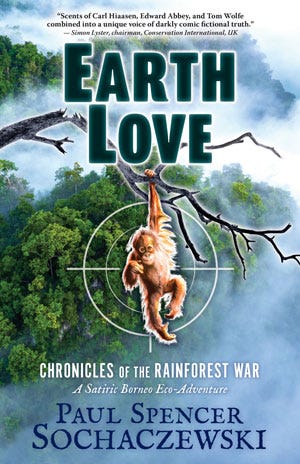
EarthLove
Chronicles of the Rainforest War

Celebrating World Rainforest Day — June 22

My three novels in the Borneo Trilogy deal with the fight to save the people and nature of the rainforests. Is there hope for the forces of good to outlast the armies of greed?
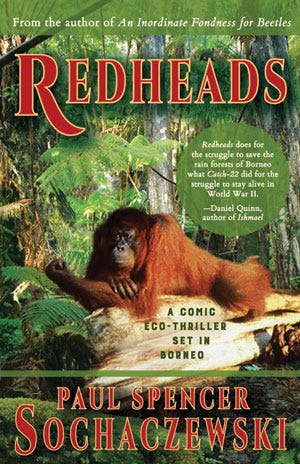
Here are three short excerpts from EarthLove. For more information about this volume, and the other two books in the series — Redheads, and the soon-to-be published Jungle Gyre, due out at the end of July — see below.

Narrator’s Note
I am a combatant. I helped start the Rainforest War, and still, in my eighth decade of an undeservedly charmed life, I continue the battle. I know the people in this novel, sometimes as colleagues, occasionally as opponents, once in a while as drinking pals and fellow softball players. I’ve changed some names and exaggerated some events. I wasn’t present for all the incidents, and in those cases, I have speculated about what might have taken place. In many places, I have written outright lies. Let’s call such a technique literary-enhanced-reality. Some readers might find this book disjointed, overblown, confusing, prejudiced, and in need of a good trim. But such is the nature of the rainforest (and war) — it is messy and doesn’t welcome being organized into a neat space.
I understand mess. At the personal level, each of us has a collection of filters through which we catalogue our memories, sometimes enhancing them to meet the insatiable desires of our fragile egos, sometimes erasing them to ease the pain of battles lost.
The Rainforest War exposes countless natural and human facets, where black-and-white fact and fiction, and winners and losers, are elusive concepts. Nature bears the sacrificial brunt of human greed and confusion. Bruno Manser’s body in an unmarked shallow grave, eco-activist Chico Mendes’s memory covered in martyr’s mold. The unburied corpses in Sumatra of Martua Parasian Siregar and Maraden Sianipar, stabbed because they investigated illegal oil palm operations. The body of Homero Gómez González found floating in a Mexican well because he fought illegal loggers destroying the breeding grounds of monarch butterflies.
Strangling figs, and dipterocarp giants whose seeds fly like tiny helicopters in search of a welcoming bit of mud and sun. Stunning bits of natural bling amid swathes of yucky muck. Tangled lianas, entangled liaisons. Monogamous hornbills whooshing through the branches like lonely distant trains, wild boar migrations in the thousands.
Where you might walk an hour in a seemingly straight line and wind up back where you started. Redundancy a thousand times over. The battles rage, with clever strategies for attack and deceit hiding under each leaf; beasties that watch patiently, then snipe; critters that hide in plain sight, hoping to live another hour.
People who look at the rainforest and see food, or beauty, or yellow-wagtail omens, or PhDs. Others see demons, snowmen of the jungle, and tiger magicians. Some people, without an influential voice, see their homelands, their heimats, that define who they are. Too many outsiders who see money.
In the Rainforest War, you can’t easily disentangle the cycles of growth, decay, and regrowth. Say a prayer for earthworms and dung beetles.
Peter Socrates Walburton
Washington, DC

Prologue
Otak Pusing National Park, Sarimantan, Borneo
1978
The male orangutan, an adolescent perhaps eight years old, did not have a name. Let’s call him Ringo, because of the star-shaped scar on his forehead he got when he fell out of the night nest as a baby.
Ringo lived in the Otak Pusing National Park in the southern Borneo nation of Sarimantan. He had been on his own for a couple of years, after his mother’s nudging, and the realization that she wasn’t going to feed him forever left him with no choice. So, he wandered. Hesitantly.
The young Ringo rambled. He tried to remember the location of the fruiting fig and durian trees that his mother had taken him to. Along the way he found a few other orangutans his age to spend some time with. He’d socialize a bit, then drift away.
He avoided snakes. He got stung by bees. He lost his balance and fell trying to reach an awkwardly placed fruit.
When it rained Ringo curled up in a tree and ludicrously, at least to an observer, tried to cover himself with leaves. When the sun came out and steam rose from the rainforest floor Ringo was off again.
In the distance Ringo heard an alien sound. It was the whine of a chainsaw. Ringo wandered away, but the sound remained, diffused on the heavy air. Eventually he retreated further into the forest and the natural aural balance was restored.
It was not a good life or a bad life. It was a life, and he took things as they came.

Chapter I
Mount Malu National Park, Mahamaya, Borneo
1978
In Mahamaya, the country to the north of Sarimantan, which occupied the northern third of Borneo, researcher Kristin Borin was in a rainforest similar to Ringo’s. She was accompanied by Tukang Ajaib, a Penan tribal shaman.
His name meant “purveyor of magic,” but she didn’t know that at the time. She was a newbie, a rainforest virgin, where everything was wonderful and confusing and exciting and, to be honest, a bit overwhelming.
Kristin had hit the anthropological jackpot. Just out of Georgetown grad school (BA in botany, master’s in psychology, and a Ph.D. in anthropology), she had scored a job with the International Nature Federation to study the ethnobotany of the Penans, a dwindling group of semi-nomadic hunters who lived in both Mahamaya and Sarimantan.
Well, to call it a job is a bit of an overstatement. She received a tiny stipend and virtually no logistical support.
She had built, with the help of local villagers who were happy to earn a few dollars and help a pretty blonde woman, a simple but (thankfully) leak-proof one-room hut. She lived just inside Mount Malu National Park. . . .
Publishing Date: July 28, 2026
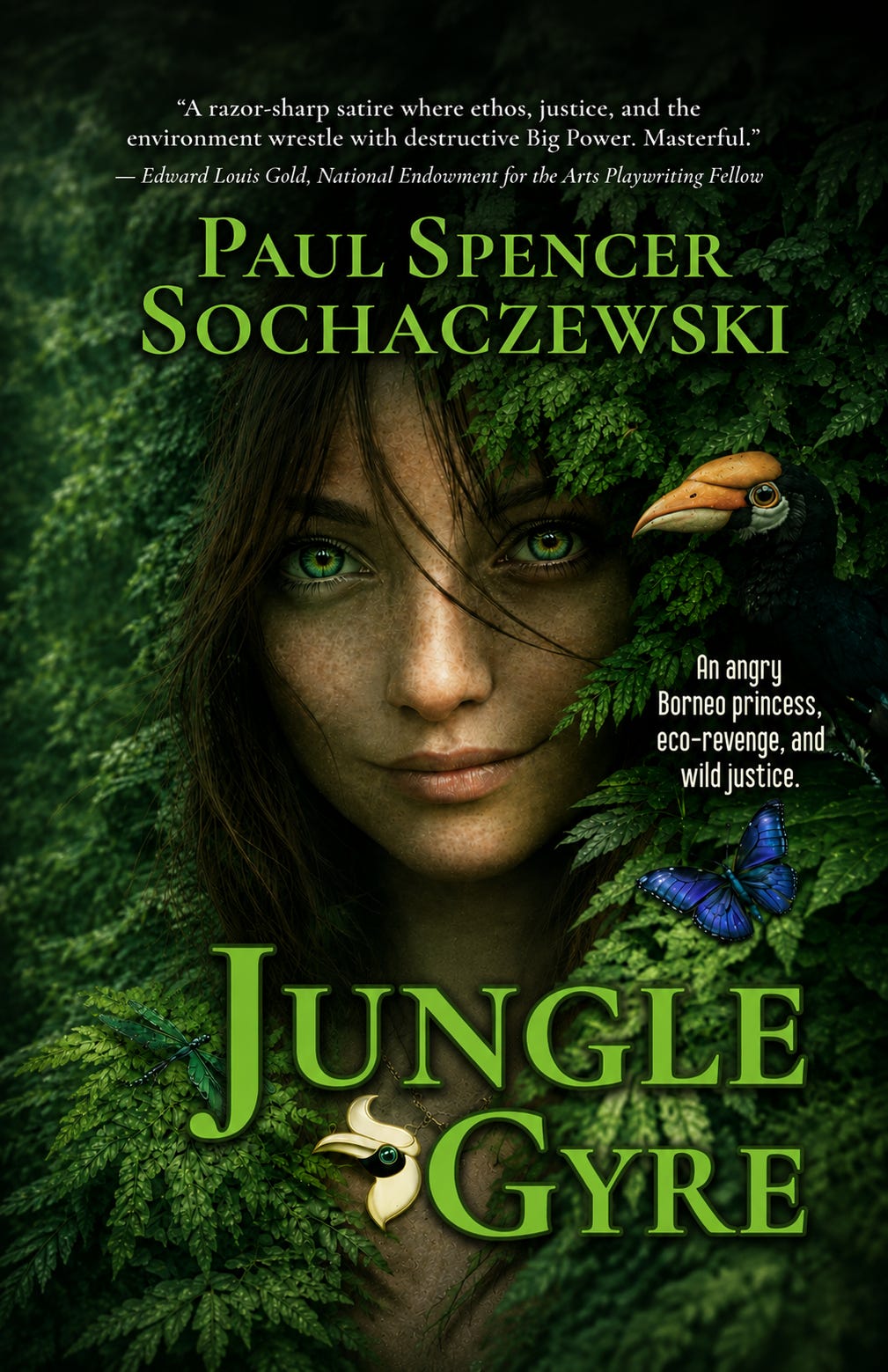
“Quietly defiant Princess Tara confronts a reality where ancient ecosystems are traded for fast profit. Jungle Gyre is more than a good story; it is a warning: Who will stand for the living Earth before it is too late?”
— Peter Kallang, chairman of SAVE Rivers, Sarawak, Malaysia
“Jungle Gyre’s ethical questions resonate with the events we see on the news every day. When is violence justified? The result feels as if George Orwell collaborated with Doctor Strangelove, Tom Wolfe, Graham Greene, and the Monkey Wrench Gang to save the world.”
— Daniel Warner, author of An Ethic of
Responsibility in International Relations
Late, but I've strapped on my boots, cleared my eyes, and walked outside. Just ordered A Conservation Notebook.